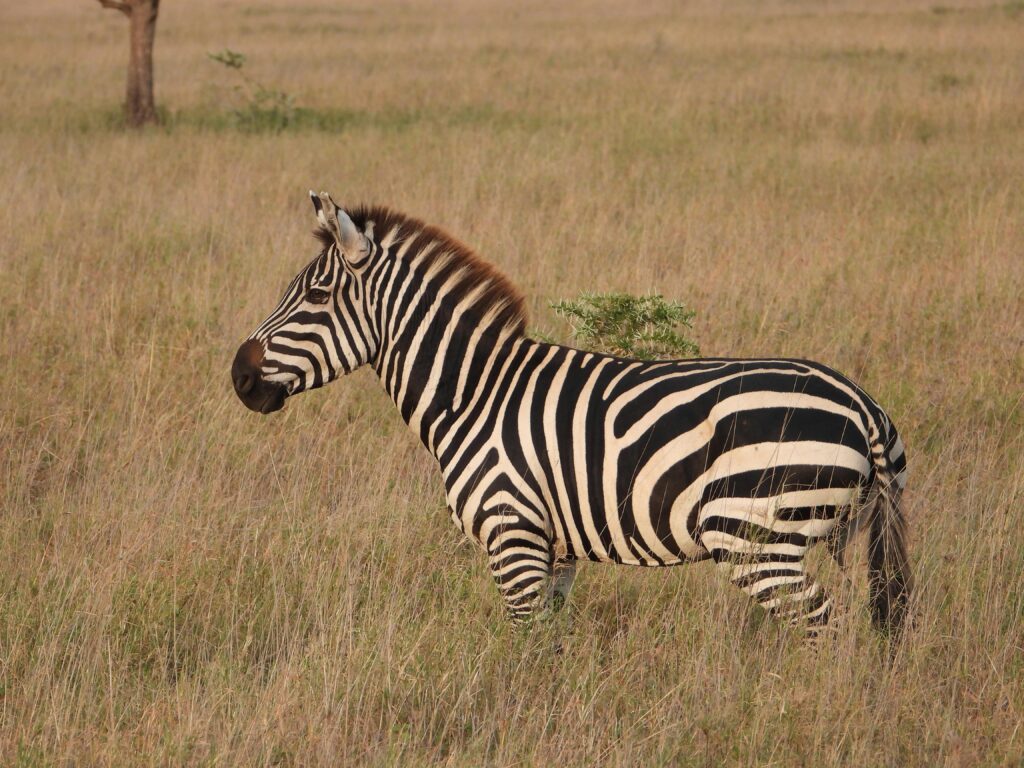
The Striped Horse of the Savanna
A true icon of the African continent, hunting a wild zebra is a classic safari experience. Despite their horse-like appearance, zebras are exceptionally alert herd animals with superb eyesight and hearing. Their famous striped coats provide incredible camouflage, creating an optical illusion that makes it difficult to single out an individual in the brush. Furthermore, they are legendary among Professional Hunters for being incredibly tough and resilient, demanding flawless shot placement.
Overview & Demographics
- Average Mature Stallion Weight: 600 – 850 lbs (270 – 385 kg)
- Shoulder Height: 50 – 55 inches (125 – 140 cm)
- Lifespan: 20 – 25 years in the wild
- Primary Habitat: Open grasslands, savannas, and lightly wooded bushveld. They are highly dependent on surface water and must drink daily.
- Trophy Characteristics: Unlike horned game, a zebra trophy is judged entirely on the quality of its flat skin or rug. A premium trophy will have striking, high-contrast striping, a full standing mane, a complete tail, and minimal fighting scars. While both stallions and mares can be legally hunted in many areas, a mature stallion is the traditional target.
Trophy Evaluation & Identification
Field judging a zebra focuses on sex identification and hide quality. Sexing a zebra is notoriously difficult because stallions and mares look nearly identical and both are heavily muscled. A Professional Hunter will look for the thicker neck of a stallion, broader chest, and behavioral cues (stallions often trail at the back of the herd). From a trophy perspective, hunters must look through their optics to check for heavy scarring on the neck, shoulders, and hindquarters, which are common from stallion fights and predator attacks.
Habitat & Hunting Tactics
Zebra are exclusively herd animals, which makes the spot-and-stalk approach challenging. Dozens of eyes and ears are constantly on watch. The primary challenge is closing the distance without being spotted, and then isolating the chosen stallion from the tightly packed herd to ensure a safe, clear shot. They are often found grazing alongside wildebeest and impala. A classic zebra tactic is to utilize their curiosity; if spooked, a herd will often run a short distance, stop, and turn broadside to look back, offering a brief window for a shot.
Firearm & Calibre Requirements
- The Minimum Standard: While a .270 Winchester can get the job done, it is widely considered too light for zebra due to their incredibly dense muscle mass and sheer tenacity.
- The Ideal Choice: The .30-06 Springfield or .300 Winchester Magnum are the benchmark plains game calibers and are perfect for zebra. Larger calibers like the .338 Winchester Magnum or even a .375 H&H are never overkill on this specific animal.
- Ammunition: Premium, controlled-expansion bullets (like the Swift A-Frame or Barnes TSX) in the 180 to 200-grain range are strictly mandatory. A zebra will absorb a poorly placed or fragile bullet and run for miles. Deep penetration through heavy shoulder muscle is required.
- Optics: A standard 3-9x or 4-12x variable scope is ideal, as shots are typically taken in open savanna at ranges between 100 and 200 meters.
Zebra Anatomical Shot Placement
Broadside – Ideal: A zebra’s vital zone (heart and lungs) sits slightly further forward than on many antelope species. Trace the vertical line of the front leg straight up into the body, stopping one-third of the way up from the bottom of the chest. Aiming directly on the shoulder triangle is highly recommended to break the skeletal structure and anchor the animal immediately.
Common Errors: The most frequent mistake hunters make is shooting too far back. The striped pattern can create an optical illusion that draws the eye toward the center of the mass. A shot placed behind the shoulder crease often results in a gut-shot and an agonizingly long tracking job.