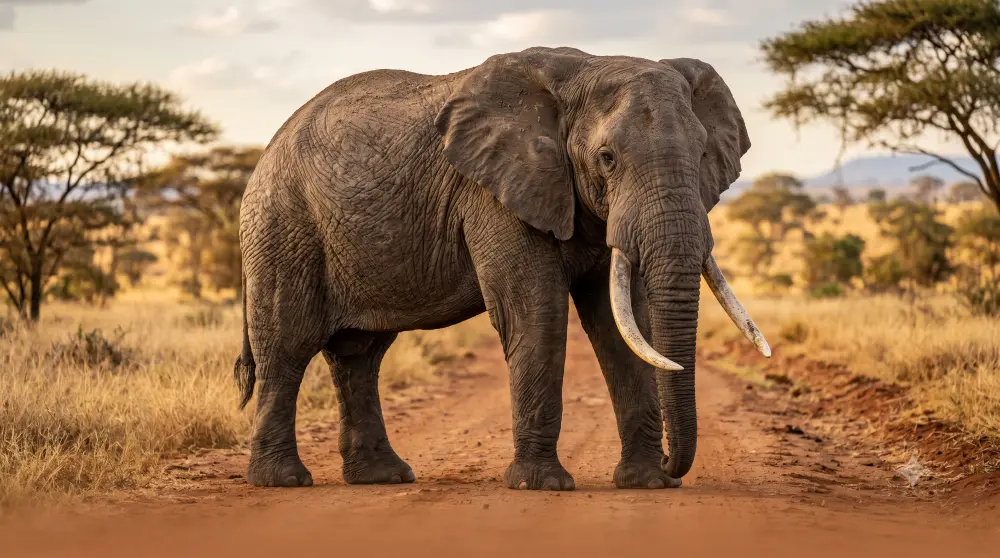
The Monarch of the Savanna
The absolute pinnacle of dangerous game hunting. Pursuing the African elephant is an awe-inspiring, profoundly humbling experience that demands exceptional physical endurance and mental fortitude. It involves miles of relentless tracking on foot through harsh terrain, ultimately culminating in a close-quarters encounter with the largest land mammal on earth.
Overview & Demographics
- Average Mature Bull Weight: 10,000 – 13,000 lbs (4,500 – 6,000 kg)
- Shoulder Height: 10 – 13 feet (3 – 4 meters)
- Lifespan: 60 – 70 years in the wild
- Primary Habitat: Incredibly adaptable. They thrive in dense mopane forests, open savannas, miombo woodlands, and even the arid deserts of Namibia.
- Trophy Characteristics: Judged almost entirely by tusk weight and length. A mature bull is typically distinguished by a thick, heavy base where the ivory meets the lip, deep hollows above the eyes, and a prominent fold at the top of the ear. The SCI minimum score is 90 pounds (combined weight of both tusks).
Trophy Evaluation & Identification
Field judging ivory is an art form that takes Professional Hunters years to master. Because a significant portion of the tusk is hidden inside the skull (the nerve cavity), judging weight relies on assessing the circumference of the ivory at the lip line and how far it projects outward. Older bulls will often have worn, blunted, or broken tips from years of digging and fighting, but they carry massive weight in the base. It is also critical to confirm the sex of the animal, as older cows can carry long, thin ivory that can deceive an untrained eye.
Habitat & Hunting Tactics
Elephant hunting is synonymous with tracking. A standard day involves cutting a fresh track on a dirt road or at a waterhole at first light, and following the spoor on foot for miles. Skilled trackers will analyze dung temperature and footprint clarity to determine the age of the track. The final approach is almost always at incredibly close range (15 to 30 meters) in thick cover. The wind must be absolutely perfect, as an elephant’s sense of smell is arguably the best in the animal kingdom.
Firearm & Calibre Requirements
- The Legal Minimum: The .375 H&H Magnum is the legal minimum, but it is generally considered light for a mature bull elephant.
- The Professional Standard: The .416 Rigby, .416 Remington Magnum, and .458 Lott are the modern benchmarks. They offer the necessary momentum to drive a bullet through inches of dense skull bone or heavy muscle.
- The Heavy Doubles: For true close-quarter stopping power, side-by-side double rifles in .470 Nitro Express or .500 Nitro Express are the traditional and highly favored tools of Professional Hunters.
- Ammunition: Monolithic solid bullets are strictly mandatory. Expanding soft-point bullets will fail against the elephant’s massive skeletal structure. Extreme, straight-line penetration is the singular goal.
The Brain Shot vs. The Heart Shot: The frontal brain shot is the most iconic, yet most difficult, shot in hunting. The brain sits surprisingly low and far back in the skull. For a frontal approach, aim slightly above the imaginary line connecting the eyes, adjusting based on the angle of the head. A broadside heart shot is often safer; trace up the back of the front leg about one-third into the body mass. The heavy leg bones require premium solid ammunition to break through.