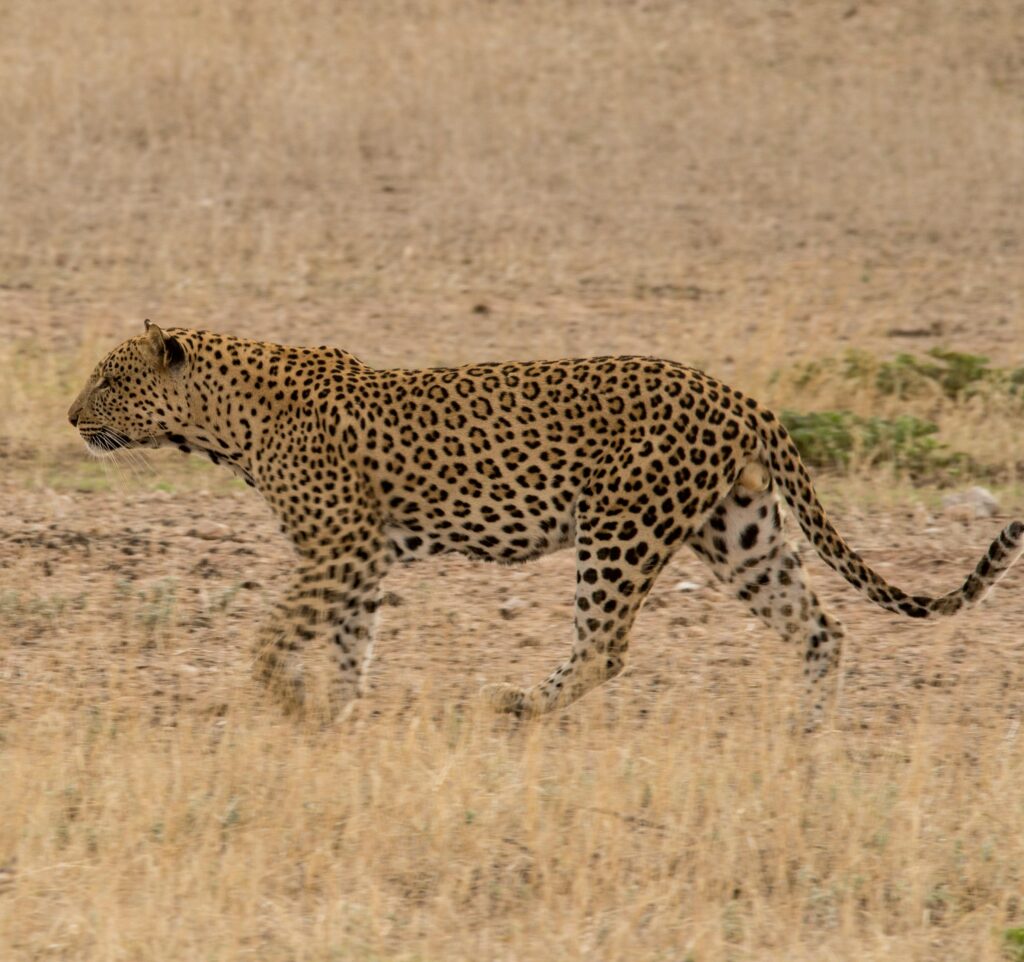
The Ultimate Feline Ghost
The ultimate feline ghost. Hunting a leopard is less about physical exertion and entirely about psychological endurance, flawless baiting strategies, and absolute precision under extreme pressure.
Overview and Demographics
- Average Mature Tom Weight: 130 – 180 lbs (60 – 80 kg)
- Shoulder Height: 24 – 28 inches (60 – 70 cm)
- Lifespan: 12 – 15 years in the wild
- Primary Habitat: Highly adaptable. Found in dense bushveld, riverine forests, rocky kopjes, and mountainous terrain.
- Trophy Characteristics: A mature tom is characterized by a thick, muscular neck, a large “blocky” head, and a heavy dewlap. The SCI minimum score is typically 14.5 inches.
Trophy Evaluation & Identification
Judging a leopard from a dark blind in low light is notoriously difficult, making reliance on your Professional Hunter’s assessment critical. You are looking for a massive, blocky head and a thick neck that seems to flow directly into the shoulders without a taper. A large, mature tom will make a standard bait (like an impala quarter) look small by comparison. Females, which are strictly protected in most hunting areas, will have a notably smaller, more refined head and a slender neck.
Habitat & Hunting Tactics
Leopard hunting is almost exclusively conducted over bait from a meticulously concealed blind. The tactic involves hanging bait (such as impala, zebra, or warthog) high in a carefully selected tree with a strong horizontal branch. Trail cameras are utilized heavily to confirm the size, sex, and feeding times of a visiting cat. The hunt itself requires absolute, agonizing stillness and silence inside the blind for hours—usually during the late afternoon and deep into the night—waiting for the ghost to materialize.
Firearms & Calibre
- The Caliber Debate: While the .270 Winchester or .30-06 Springfield is legally sufficient in some jurisdictions, they are generally considered too light for modern standards.
- The Professional Standard: The .300 Winchester Magnum is excellent, but many Professional Hunters strongly prefer the .375 H&H Magnum. While a leopard is thin-skinned, a wounded cat in the long grass is lethal. Heavy knock-down power to anchor the cat on the branch is non-negotiable.
- Ammunition: Deep penetration is not the goal. Rapid-expanding, premium soft-point bullets are mandatory to ensure massive shock and immediate energy transfer.
- Optics: This is arguably more important than the rifle. High-quality glass with exceptional low-light transmission (like a 56mm objective lens) is critical. An illuminated reticle is highly recommended for rapid target acquisition in near-total darkness.
Leopard Anatomical Shot Placement
The vital zone on a leopard is surprisingly compact, and shot placement must be perfect. Given that a leopard is most often shot from a blind at a known distance (usually around 30-50 meters) while the cat is on a bait branch, a precise broadside shot is the gold standard. A marginal hit on a thin-skinned, high-adrenaline cat will almost certainly result in a lethal follow-up tracking job.
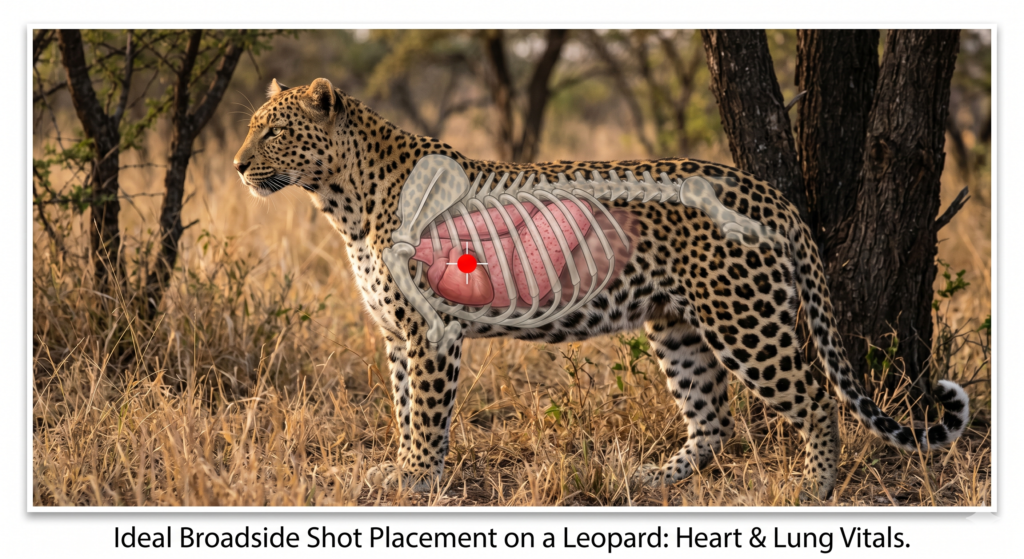
Broadside – Ideal: Position the vertical crosshair perfectly aligned with the back edge of the front leg. Set the horizontal crosshair one-third of the way up from the bottom edge of the chest. This aligns the bullet trajectory with the heart and lower lungs while minimizing heavy bone interference.