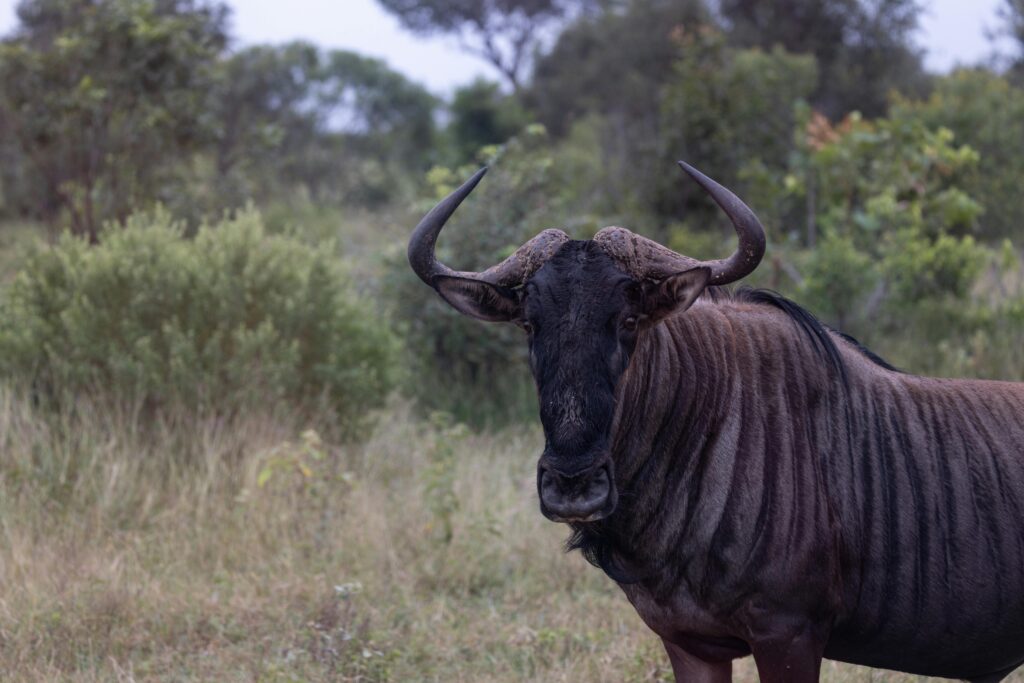
The Poor Man’s Buffalo
With its humped shoulders, sloping back, and shaggy mane, the Blue Wildebeest looks like a creature from a prehistoric era. They are a staple of the African plains and highly sought after by hunters. However, they have earned a legendary reputation for their astonishing tenacity and will to live. A Wildebeest is heavily muscled, dense-boned, and will absorb a poorly placed bullet without breaking stride, making precise shot placement the ultimate priority on this hunt.
Overview & Demographics
- Average Mature Bull Weight: 500 – 600 lbs (230 – 270 kg)
- Shoulder Height: 50 – 58 inches (130 – 150 cm)
- Lifespan: 15 – 20 years in the wild
- Primary Habitat: Open savannas, grasslands, and acacia bushveld. They are grazers and are highly dependent on regular access to surface water.
- Trophy Characteristics: Judged by the outside spread of the horns, the thickness of the central boss, and how deeply the horns curl downward before sweeping back and up. The SCI minimum score for a Southern Blue Wildebeest is 70 inches.
Trophy Evaluation & Identification
Field judging a Blue Wildebeest is tricky because both bulls and cows possess horns and look remarkably similar from a distance. A Professional Hunter will look closely at the central boss (the base of the horns on the forehead); a mature bull will have a heavily thickened, corrugated boss with a very narrow gap between the horns, whereas a cow’s boss is flat and narrow. Bulls also possess a much thicker, heavier neck, a darker facial coat, and horn tips that sweep noticeably further backward.
Habitat & Hunting Tactics
Wildebeest are classic herd animals, often found in large numbers grazing alongside zebra. The standard hunting tactic is spot-and-stalk. Because there are so many eyes and ears in a herd, the stalk must use available cover strategically. Once in range, the challenge shifts to isolating the mature bull from the constantly shifting, tightly packed herd to ensure a safe shot without risking a pass-through that could hit an unseen cow or calf behind him.
Firearm & Calibre Requirements
- The Minimum Standard: While technically a .270 Winchester is adequate for perfect broadside shots, it is widely considered too light for the thick shoulders of a wildebeest by most Professional Hunters.
- The Ideal Choice: The .30-06 Springfield, .300 Winchester Magnum, or 7mm Remington Magnum are the gold standards. They provide the necessary terminal energy to break heavy bone and reach the vitals.
- Ammunition: Premium, controlled-expansion bullets (such as Barnes TSX, Swift A-Frame, or Nosler Partition) in the 180-grain class are absolutely mandatory. Standard cup-and-core bullets will frequently disintegrate on the wildebeest’s thick shoulder muscles.
- Optics: A standard 3-9x or 4-12x variable scope is ideal for shots typically taken between 100 and 200 meters.
Wildebeest Anatomical Shot Placement
Broadside – Ideal: The Blue Wildebeest’s anatomy creates a famous optical illusion. Because of the high hump on their shoulders, hunters frequently shoot too high, hitting the “empty” space above the spine, which results in a lost animal. Trace the front leg straight up into the body, exactly one-third of the way up from the bottom of the brisket. Aim directly for the point of the shoulder to break the skeletal structure and destroy the heart and lungs.
Quartering Away: Aim for the off-side shoulder. The bullet must enter behind the near-side ribs to travel forward and diagonally through the vital cavity.