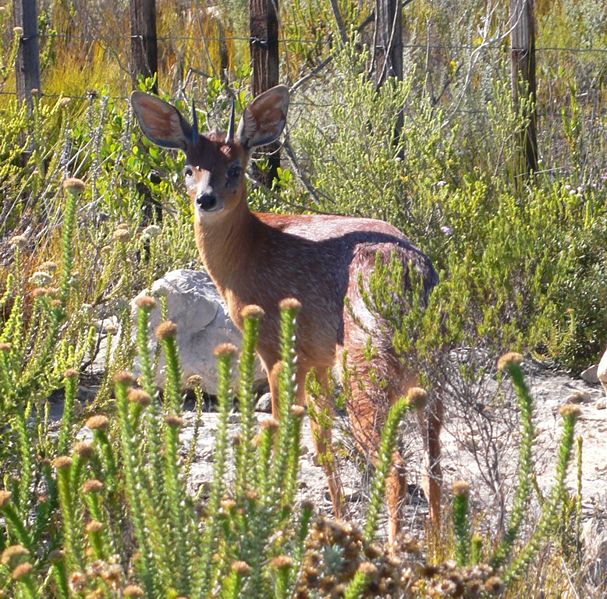
The Rufous Ghost of the Fynbos
Native almost exclusively to the dense coastal scrub and fynbos of South Africa’s Western and Eastern Cape, the Cape Grysbok is a premier target for collectors pursuing the “Tiny Ten.” Distinctive for its reddish-brown coat heavily flecked with white hairs—giving it a grizzled or “grey” appearance (hence the Afrikaans name “Grysbok”)—this predominantly nocturnal and incredibly shy dwarf antelope presents a formidable test of patience, optics, and rapid marksmanship.
Overview & Demographics
- Average Mature Ram Weight: 18 – 25 lbs (8 – 11 kg)
- Shoulder Height: 21 – 22 inches (54 – 56 cm)
- Lifespan: 8 – 10 years in the wild
- Primary Habitat: Extremely dense coastal scrub, mountainous fynbos, and thick riverine brush. They rarely venture far from deep cover and are highly active at night.
- Trophy Characteristics: Only rams possess horns, which are short, straight, smooth, and point almost vertically from the head. The SCI minimum score for a Cape Grysbok is 4 inches (combined length of both horns).
Trophy Evaluation & Identification
Field judging a Grysbok is exceptionally difficult because sightings are usually fleeting and occur in very low light. A Professional Hunter will look closely at the horns relative to the ears; a mature trophy ram will have horns that equal or slightly exceed the length of the ears. Because they live in such abrasive, thick brush, older rams often have chipped or blunted horn tips. Confirming the presence of horns is the first priority, as ewes are identical in body size and coloration but are entirely hornless.
Habitat & Hunting Tactics
Because the Grysbok is primarily nocturnal, hunting them requires capitalizing on the very first 30 minutes of dawn and the last 30 minutes of dusk. The standard tactic involves quietly glassing the edges of agricultural fields, vineyards, or small clearings in the fynbos where they step out to feed. They are extremely nervous and will dive back into impenetrable cover at the slightest sound. Unlike a Duiker, a Grysbok rarely stops to look back once it decides to run, meaning the hunter must be perfectly set up on shooting sticks before the animal is fully exposed.
Firearm & Caliber Requirements
- The Ideal Caliber: Small-bore, flat-shooting centerfire rifles like the .22 Hornet, .222 Remington, .223 Remington, or .243 Winchester are the absolute best tools for this hunt.
- Ammunition Warning: Because the Grysbok is so small and is highly prized for full-body taxidermy mounts, pelt preservation is critical. If using a larger plains game caliber, hunters must use non-expanding monolithic solid bullets to ensure the bullet passes cleanly through without blowing out the off-side shoulder.
- Optics: This is where high-end glass is non-negotiable. Because almost all shots are taken in very poor lighting conditions at dawn or dusk, a scope with a large objective lens (50mm or 56mm) and an illuminated reticle is highly recommended to clearly see the target against the dark brush.
Cape Grysbok Anatomical Shot Placement
Broadside – Ideal: The vital zone on a Grysbok is incredibly small, requiring surgical precision. Trace the back of the front leg straight upward, aiming exactly one-third of the way up the body mass. A steady rest is absolutely essential, as pulling the shot slightly into the stomach or hindquarters will result in a lost animal in the thick fynbos.
The Head/Neck Shot: For highly proficient marksmen shooting larger calibers, a shot to the high neck or base of the skull is often recommended to completely preserve the body cape for a full mount.