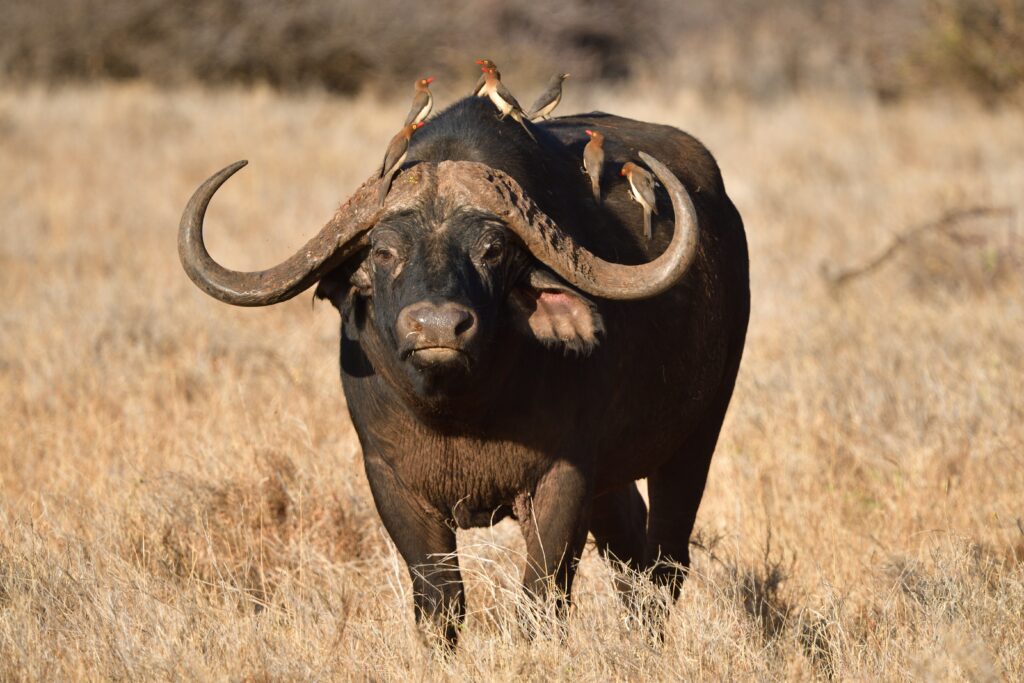
Cape Buffalo
The Black Death: Africa’s Most Formidable Bovine
Widely considered one of the most dangerous game species on the African continent, the Cape Buffalo (Syncerus caffer caffer) commands absolute respect. As a cornerstone of the legendary Big Five, hunting “The Black Death” is the ultimate test of nerve, stamina, and marksmanship. Known for their unforgiving temperament, incredible heavy-boned anatomy, and tendency to ambush when wounded, a buffalo safari is not merely a hunt—it is a pursuit that demands rigorous physical and mental preparation and nerves.
Vital Statistics
- Average Mature Bull Weight: 1,500 – 1,900 lbs (680 – 860 kg)
- Trophy Characteristics: A mature “Dagga Boy” is judged by a hardened, fully fused central boss, dropping deeply before sweeping up to the tips. A spread of 38 to 40 + inches is widely considered the benchmark.
- Primary Habitat: Dense bushveld, mopane scrub, grassland, riverine thickets, and reedbeds. They are highly water-dependent and must drink daily.
- Shoulder Height: 51 – 59 inches (130 – 150 cm)
- Lifespan: 15 – 20 years in the wild
Fieldcraft & Tactics
Hunting the Cape Buffalo is the ultimate test of African fieldcraft. They are herd animals with exceptional senses of smell and hearing, though their eyesight is relatively moderate. Older bulls—often referred to as “Dagga Boys”—will frequently splinter from the main breeding herds in groups of two to five. These solitary or small-group bulls are generally the primary target for hunters, as they carry the hard-bossed genetics desired for a mature trophy. Tracking must be slow, deliberate, and strictly mindful of the wind. A wounded buffalo is legendary for circling back on its own tracks to ambush pursuers from dense cover.
Ballistics & Gear
- The Legal Minimum: The .375 H&H Magnum is the legally mandated minimum in most African jurisdictions (including South Africa,Tanzania and Zimbabwe). While capable with precise shot placement, it is generally considered the absolute floor for Buffalo.
- The Professional Standard: The .416 Rigby, .416 Remington Magnum, and .458 Lott are widely considered the ideal modern buffalo calibres. They offer a brilliant balance of manageable recoil, heavy bullet weight (400+ grains), and devastating stopping power.
- Close-Quarter Insurance: For tracking wounded buffalo in extremely thick cover, a .470 Nitro Express (or similar heavy double rifle) is the traditional tool of choice for Professional Hunters.
- Ammunition Strategy: Your first shot should always be a premium, controlled-expansion soft point (such as a Swift A-Frame or Barnes TSX) to destroy the lungs without risking over-penetration into the rest of the herd. Subsequent rounds in the magazine should be heavy, flat-nosed solids to guarantee straight-line penetration through heavy bone on a fleeing or charging animal.
- Optics: Shots are typically taken at close quarters (40 to 80 metres) in heavy brush. A low-power variable scope (such as a 1-4x or 1-6x) on quick-detach mounts, or high-visibility express iron sights, are essential for rapid target acquisition.
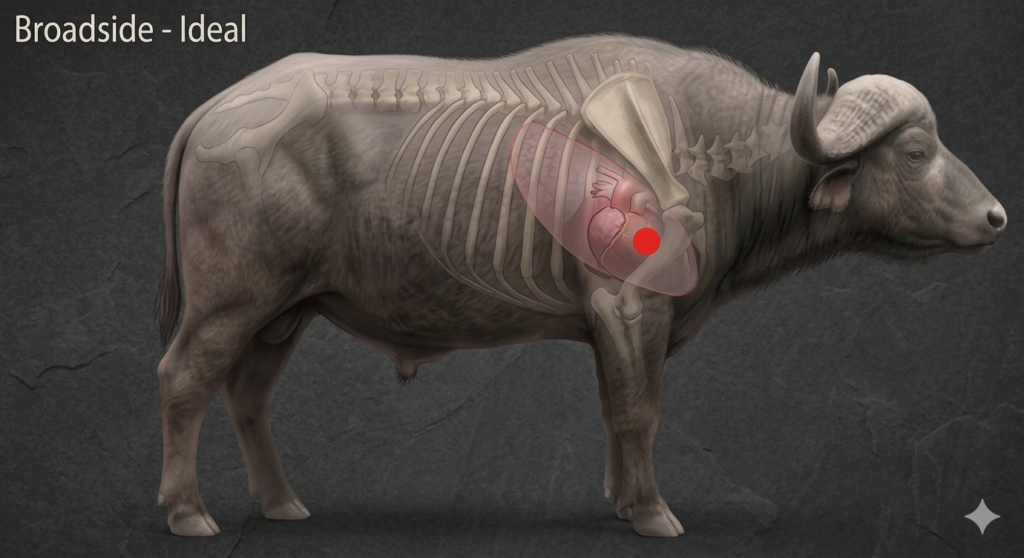
Broadside Shot: “This is the gold standard. Trace the center of the front leg straight up approximately one-third into the body mass. The goal is to break the heavy shoulder structures while simultaneously destroying the heart and the top of the lungs. Avoid the “behind the shoulder” crease shot common in deer hunting; on a buffalo, this often results in a single-lung or gut shot.”
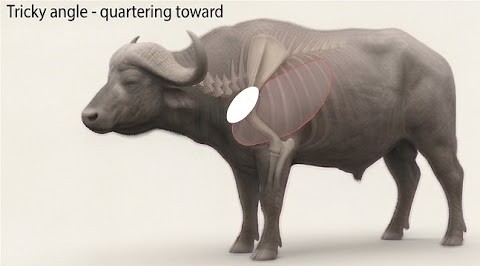
Quartering-Towards Shot: “A challenging shot that requires precise anatomical knowledge. The heavy shoulder bone may obstruct the vitals. Aim slightly behind the near front shoulder crease, targeting the far lung/heart quadrant. Deep-penetrating solids or premium expanding bullets are required to clear the shoulder bone and reach the vitals.”
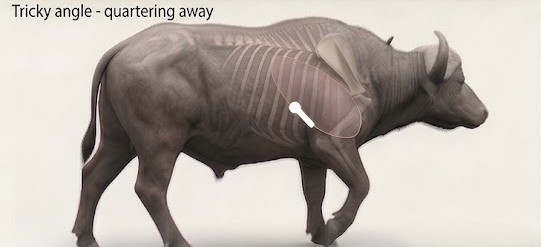
Quartering-Away Shot: “Aim for the off-side (far) shoulder. The bullet must travel through the vitals before lodging in or exiting the far shoulder. This is a highly effective shot as it often incapacitates the animal’s ability to flee.”
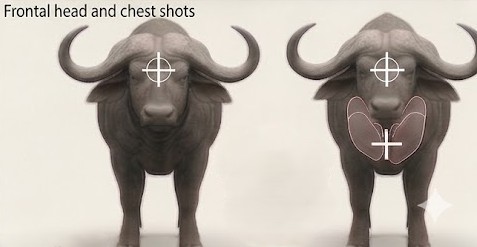
Frontal Shot: “Only recommended for experienced hunters with heavy calibres. The aiming point is the center of the chest, right at the base of the neck where it meets the brisket. This shot requires a heavy premium bullet (ideally a solid) to penetrate the dense chest musculature and reach the heart.”