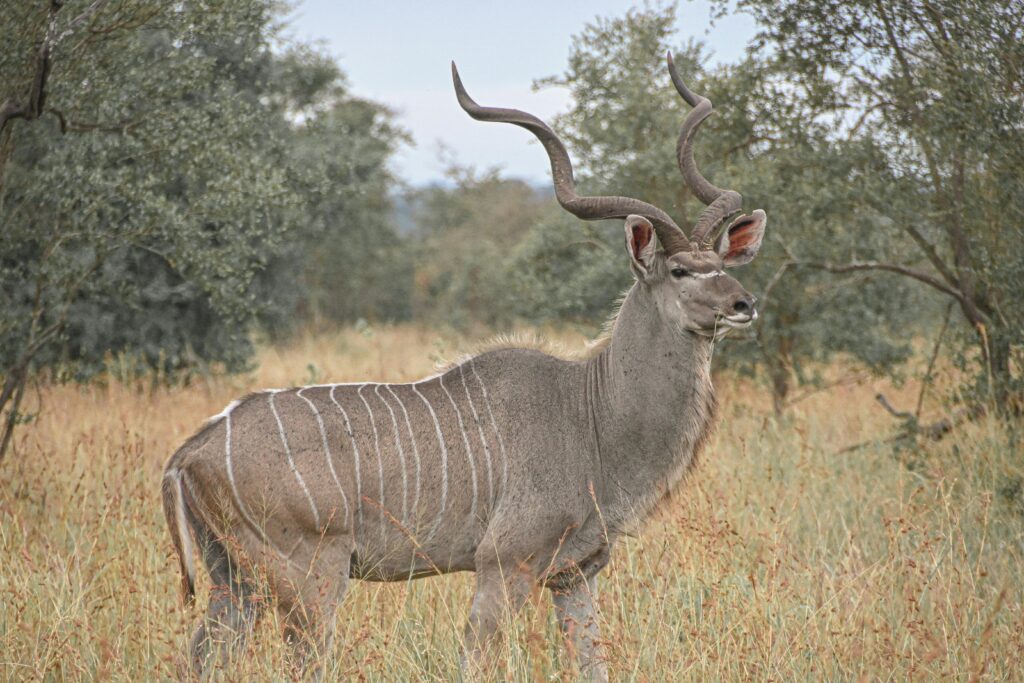
The Grey Ghost of the Bushveld
Often considered the ultimate symbol of African plains game hunting, the Greater Kudu is a majestic, elusive, and highly intelligent antelope. Earning the moniker “The Grey Ghost” for their uncanny ability to vanish silently into the brush despite their massive size, a mature Kudu bull is a master of camouflage and evasion. Hunting one requires exceptional glassing skills, patience, and a willingness to cover harsh, rocky terrain.
Overview & Demographics
- Average Mature Bull Weight: 450 – 600 lbs (200 – 270 kg)
- Shoulder Height: 55 – 60 inches (140 – 150 cm)
- Lifespan: 10 – 15 years in the wild
- Primary Habitat: Thick bushveld, mopane woodlands, and rocky, mountainous hillsides. They are browsers, preferring leaves, shoots, and seed pods over grass.
- Trophy Characteristics: The hallmark of a mature bull is massive, spiraling horns. A classic trophy will have deep curls, thick bases, and tips pointing slightly forward or outward. A distinct white chevron marking between the eyes and a full neck fringe are also prominent. The SCI minimum score for a Southern Greater Kudu is 121 inches.
Trophy Evaluation & Identification
Field judging a Kudu in thick cover is notoriously difficult, as they rarely stand in the open. The primary focus is the depth of the horn curls. A standard trophy will have at least two and a half deep curls, with the tips extending past the ears. A truly exceptional bull will push past three full curls and break the 50-inch or even 55-inch mark in length. A bull with thick bases and ivory tips is highly prized. Younger bulls often have horns that point straight up or backwards and lack the massive neck girth of a mature animal.
Habitat & Hunting Tactics
The most effective method for hunting Kudu is spot-and-stalk, relying heavily on optics. Hunters typically spend the early morning and late afternoon glassing rocky hillsides, koppies, and thick riverine brush from elevated vantage points. Because a Kudu’s hearing and eyesight are phenomenal (aided by massive ears acting like satellite dishes), the stalk must be incredibly slow and deliberate. They are famous for standing perfectly still behind a single bush, completely camouflaged, until the hunter takes one wrong step, at which point they disappear with a characteristic loud bark.
Firearm & Calibre Requirements
- The Minimum Standard: The .270 Winchester is a highly capable and very popular minimum caliber for Kudu, offering a flat trajectory for longer shots across valleys or hillsides.
- The Ideal Choice: The .30-06 Springfield or .300 Winchester Magnum are considered the optimal choices. They offer a brilliant balance of flat-shooting ballistics and the terminal energy required to cleanly anchor a heavy-boned bull.
- Ammunition: Premium, controlled-expansion soft-point bullets (such as the Nosler Partition or Barnes TSX) in the 150 to 180-grain range are ideal. The bullet must be tough enough to penetrate a heavy shoulder if the bull is quartering.
- Optics: High-quality binoculars are arguably the most important piece of gear on a Kudu hunt. A rifle scope in the 3-9x or 4-12x range is perfect for threading shots through brush or reaching across a small valley.
Kudu Anatomical Shot Placement
Broadside – Ideal: Like most plains game, the vital zone (heart and lungs) sits low in the chest. Trace the vertical line of the front leg straight up about one-third of the way into the body. Because Kudu are often encountered in thick brush, hunters must ensure their shooting lane is completely clear of twigs or branches that could deflect the bullet.
Quartering Away: A highly effective angle. Aim for the off-side shoulder, allowing the bullet to enter behind the near-side ribs and travel diagonally through the heart and lungs.