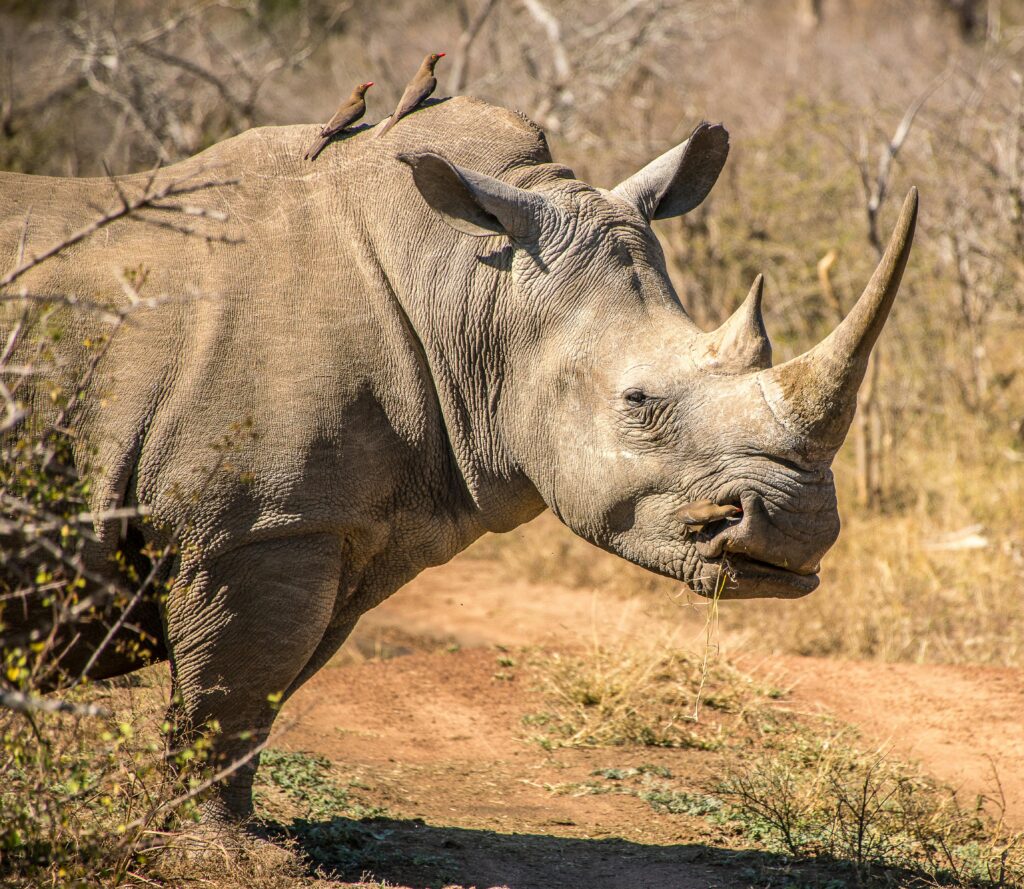
Prehistoric Juggernaut
A cornerstone of the legendary Big Five, hunting the rhinoceros is a pursuit steeped in history and modern conservation. Whether conducting a traditional stalk or a veterinary “green hunt” (darting), approaching this prehistoric, armor-plated giant on foot is a highly intense experience. Relying on their exceptional hearing and sense of smell to compensate for poor eyesight, a rhino in thick cover demands the utmost respect and fieldcraft.
Overview & Demographics
- Average Mature Bull Weight: 4,000 – 5,000 lbs (1,800 – 2,300 kg)
- Shoulder Height: 5.5 – 6 feet (1.7 – 1.8 meters)
- Lifespan: 40 – 50 years in the wild
- Primary Habitat: Open savannas, grasslands, and bushveld. They are grazers and require regular access to water for drinking and mud wallowing to regulate temperature and repel insects.
- Trophy Characteristics: Judged by the length and base circumference of the primary (front) horn, as well as the length of the secondary horn. The SCI minimum score for a Southern White Rhino is 78 inches (combined measurements of both horns).
Trophy Evaluation & Identification
Field judging a rhino focuses heavily on the front horn. A mature bull will typically have a very thick, heavy base that may taper rapidly, whereas cows often possess longer, slender horns. A Professional Hunter will look for a front horn that extends well up toward the level of the ears and a prominent secondary horn. Because rhino populations are strictly monitored, specific individuals are often pre-identified by conservation authorities for management hunts, making the Professional Hunter’s role in positive identification critical.
Habitat & Hunting Tactics
Rhino hunting is a classic spot-and-stalk or tracking operation. Because they have notoriously poor eyesight, hunters can often approach surprisingly close (20 to 40 meters) provided they remain dead quiet and play the wind perfectly. A rhino’s sense of smell is incredibly acute; a shifting breeze will instantly alert them. The stalk often involves tracking fresh spoor from a waterhole or wallow into the thicker bush where the rhino rests during the heat of the day.
Firearm and Calibre Requirements
- The Legal Minimum: The .375 H&H Magnum is the legally mandated minimum in almost all African jurisdictions, but it is generally considered the absolute floor for an animal of this sheer mass.
- The Professional Standard: The .416 Rigby, .458 Lott, or heavy double rifles like the .470 Nitro Express are the gold standards. They provide the necessary kinetic energy and momentum to push through the rhino’s incredibly thick, dense hide and heavy ribs.
- Ammunition: Premium, monolithic solid bullets are strictly required. A rhino’s hide can be over an inch thick in places, and expanding bullets run a very high risk of superficial penetration. Complete, straight-line penetration to the vitals is mandatory.
Rhino Anatomical Shot Placement
Broadside – Ideal: The heart and lung shot is the only truly reliable aiming point on a rhino. Trace the back of the front leg straight up about one-third of the way into the massive body. The vitals are large, but shielded by heavy ribs and thick skin.
Angles to Avoid: Frontal brain shots are highly discouraged. A rhino’s brain is astonishingly small for its head size and is heavily protected by dense, sloping bone and the horn base itself, making the margin for error practically zero.