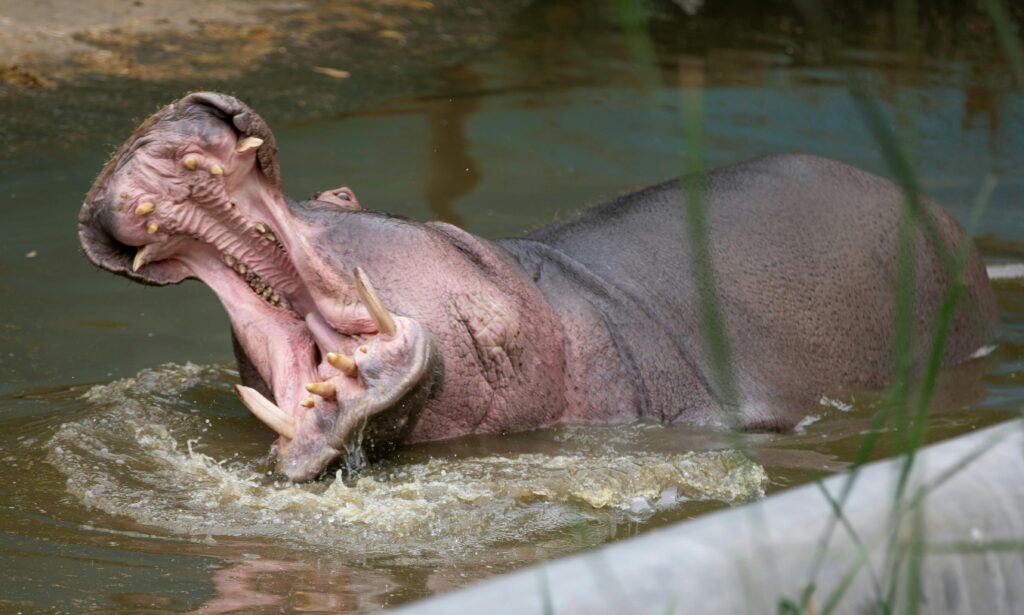
River Horse
Statistically responsible for more human fatalities in Africa than any other large mammal, the hippopotamus is fiercely territorial and unpredictable. Hunting a hippo is a highly specialized pursuit that often requires immense patience, precision optics, and surgical shot placement to anchor this massive, thick-skinned creature before it can sink into deep water.
Overview & Demographics
- Average Mature Bull Weight: 3,000 – 4,500 lbs (1,300 – 2,000 kg)
- Shoulder Height: 4.5 – 5 feet (1.4 – 1.5 meters)
- Lifespan: 40 – 50 years in the wild
- Primary Habitat: Rivers, deep lakes, and swamps. They are highly water-dependent during the day to regulate body temperature but travel miles inland to graze at night.
- Trophy Characteristics: Judged primarily by the length and circumference of the lower canine teeth (tusks), which sharpen against the upper teeth. The SCI minimum score is 50 inches (combined length of both lower tusks).
Trophy Evaluation & Identification
Judging a hippo in the water is exceptionally challenging, as only the top of the head and a portion of the back are visible. A mature bull can sometimes be identified by a wider, blockier head, a thicker neck, and prominent, fleshy mounds behind the eyes. However, to accurately judge the ivory, hunters and Professional Hunters must wait—often for hours—for the hippo to “yawn” and display its lower canines.
Habitat & Hunting Tactics
The most common method involves glassing pods of hippos from the riverbank or lake edge. Once a mature bull is identified, the hunter must wait for a clear, perfectly still head shot. If the shot is successful, the hippo will sink and typically float to the surface 1 to 3 hours later as gases expand in the stomach. An alternative, highly thrilling method involves intercepting hippos on land in the early morning as they return to the water from their nocturnal grazing, offering a dangerous dry-land encounter.
Firearm & Calibre Requirements
- The Minimum Standard: The .375 H&H Magnum is the absolute minimum, but accuracy is far more important than raw caliber size for water shots.
- The Professional Standard: The .416 Rigby, .416 Remington Magnum, or .458 Lott are excellent choices, providing the necessary insurance if a dry-land charge occurs.
- Ammunition: Monolithic solid bullets are strictly mandatory. A hippo’s skull is incredibly dense, thick bone. Standard expanding soft-points will shatter before reaching the brain, resulting in a wounded and highly dangerous animal.
- Optics: Because water shots require threading a bullet into an incredibly small target area from a distance (often 50 to 100 meters), a highly accurate, mid-power variable scope (such as a 2-8x or 3-9x) is critical.
Hippo Anatomical Shot Placement
The Brain Shot (In Water): When hunting in the water, a brain shot is the only ethical option. On a frontal profile, the target is exactly between the eyes, just above the waterline. On a broadside profile, aim for the hollow depression situated halfway between the eye and the base of the ear.
The Heart/Lung Shot (On Land): If encountering a hippo on land, a broadside heart or lung shot is highly effective. Aim straight up the front leg into the lower third of the massive body to reach the vitals.