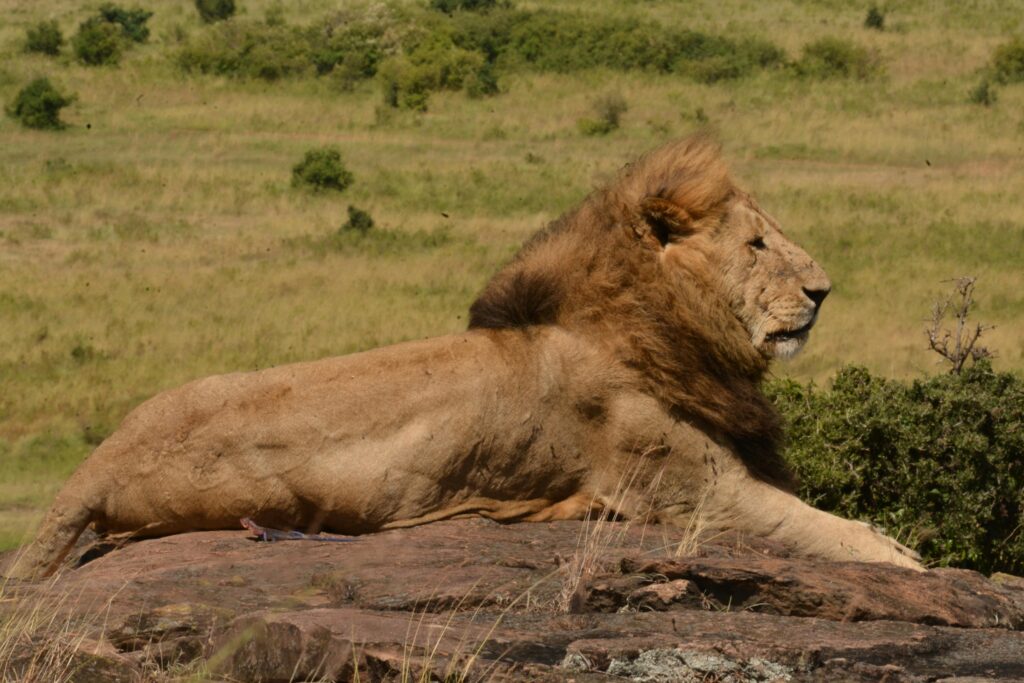
The King of Beasts
The undisputed apex predator of the African savanna. Hunting a wild lion is a visceral, adrenaline-fueled pursuit that tests a hunter’s absolute nerve. Whether tracking on foot through the Kalahari sand or waiting in a blind under the moonlight, the roar of a wild lion vibrates through the chest and remains etched in memory forever.
Overview & Demographics
- Average Mature Male Weight: 350 – 500 lbs (160 – 225 kg)
- Shoulder Height: 40 – 48 inches (100 – 120 cm)
- Lifespan: 10 – 14 years in the wild
- Primary Habitat: Highly adaptable. Found in open savannas, grasslands, dense mopane bush, and semi-desert regions.
- Trophy Characteristics: A mature male (minimum of 6 years old in most legal jurisdictions) is judged by a combination of a fully dark nose, worn teeth, facial scarring, and overall skull size. Mane development varies heavily by region and genetics. The SCI minimum score is 24 inches (skull length plus width).
Trophy Evaluation & Identification
Field judging a lion is arguably the most highly scrutinized practice in African hunting today. In almost all jurisdictions, a huntable lion must be at least six years of age. A Professional Hunter will look for a completely black, heavily pigmented nose (a pink nose indicates a young cat), heavily worn or yellowed teeth, a sagging belly, and facial scarring. While hunters often dream of a massive, dark mane, this is largely dependent on the region. Lions in hotter, brushy areas like the Selous often have sparse manes, while Kalahari lions develop thick, dark fringes. Age is the ultimate indicator of a trophy.
Habitat & Hunting Tactics
There are two primary methods for hunting a lion. The first is baiting, which involves hanging a large carcass (like a buffalo or hippo quarter) in a tree and building a meticulously concealed blind nearby. This requires immense patience and is similar to leopard hunting, though lions will often feed during the day. The second method, tracking on foot, is the traditional approach. Often utilized in sandy regions like the Kalahari, hunters and skilled Bushmen trackers will pick up a fresh track at a waterhole at dawn and follow the spoor until they catch up to the resting lion in the heat of the day.
Firearm & Calibre Requirements
- The Legal Minimum: The .375 H&H Magnum is the legally mandated minimum for dangerous game in most African countries, and it is a superb choice for lion.
- The Professional Standard: The .416 Rigby or .416 Remington Magnum are widely favored. While lions are thin-skinned predators, they possess incredibly dense muscle mass and ferocity. Massive shock and immediate energy transfer are required to prevent a lethal charge.
- Heavy Alternatives: For following up a wounded lion in thick “jesse” bush, Professional Hunters traditionally rely on heavy double rifles, such as the .450/400 or .470 Nitro Express, for rapid secondary follow-up shots.
- Ammunition: Solids should absolutely never be used for a first shot on a cat. Rapid-expanding, premium soft-point bullets are mandatory to ensure massive tissue destruction and immediate kinetic shock.
Broadside – Ideal: A lion’s vitals sit slightly further back than a buffalo’s. Trace the vertical line of the front leg upward to the horizontal midline of the body. Aim directly on that shoulder line. Breaking the shoulder bone is highly recommended on a lion to immediately anchor the cat and destroy the lungs and heart beneath it, neutralizing its ability to charge.